
Most People Remember Events. INTJs Remember Algorithms.
Meet someone once, and most people remember their name.
Meet them five times, and most people remember their personality.
INTJs often remember something entirely different; they remember the pattern.
Not because they are trying to judge people.
Their minds naturally compress hundreds of small observations into one working model.
The result can feel almost unsettling.
While others continue evaluating individual conversations, the INTJ has quietly begun predicting future behavior, a phenomenon known as psychological compression.
The Mind Was Built to Compress
The human brain cannot store every experience individually.
Instead, it searches for regularities.
Cognitive psychologists describe this process through schemas, organized mental structures that simplify complex information into usable knowledge (Rumelhart, 1980).
Experts become experts not by memorizing more information, but by recognizing more meaningful patterns.
Research by Ericsson and Kintsch (1995) showed that highly skilled individuals organize information into larger, more efficient mental structures, allowing them to recognize complex situations rapidly.
Many INTJs perform this process almost automatically.
They are constantly asking: “What kind of system is this?”
People Become Equations
Imagine meeting someone for six months.
You notice they:
- become defensive when challenged,
- avoid responsibility after mistakes,
- flatter authority figures,
- criticize absent colleagues,
- repeat the same justifications under pressure.
Most people file these away as separate memories, but INTJs rarely do.
Their mind begins to reduce those observations into a predictive equation.
Not necessarily mathematically, but psychologically.
Eventually, the equation becomes, “Under pressure, this person protects status before truth.”
As a result, future behavior becomes easier to anticipate.
The INTJ is no longer reacting to the next interaction; they’re testing an existing model.
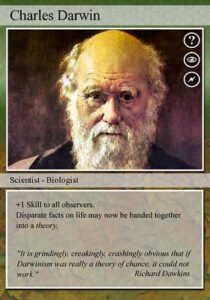
The Charles Darwin Effect
Charles Darwin spent decades observing tiny variations among plants, animals, and fossils.
To most people, these observations appeared unrelated.
Darwin kept asking a different question: “What hidden principle explains all of these differences?”
His answer became the foundation of evolutionary theory.
Biographers note that Darwin patiently accumulated evidence, resisted premature conclusions, and revised his models whenever contradictory evidence emerged (Browne, 1995).
That habit offers an instructive analogy for many INTJs.
Rather than making snap judgments about people, they often accumulate observations over time.
Only after enough evidence exists do they begin forming a predictive model.
The goal is not certainty, but the probability closest to accuracy.
The Concept of Behavioral Compression
This process differs from stereotyping.
Stereotypes begin with assumptions.
Behavioral compression begins with observation.
INTJs often compress information into questions such as:
- What motivates this person?
- Which behaviors repeat regardless of circumstance?
- Which values remain stable under stress?
- Which actions contradict stated beliefs?
Eventually, dozens of interactions coalesce into a single, simplified framework.
The framework is easier to remember than every conversation.
More importantly, it predicts future behavior.
Why This Makes People Uncomfortable
People generally expect to be evaluated by what they say today.
INTJs often evaluate people by what they have consistently done over time.
That creates an unsettling feeling for many.
Someone may believe they are starting over, but the INTJ believes the data set simply grew larger.
Research on thin-slice judgments suggests people can draw meaningful conclusions from surprisingly small behavioral samples, although accuracy improves substantially as observations accumulate (Ambady & Rosenthal, 1992).
INTJs often extend this process over months or years rather than minutes.
The Hidden Risk
Psychological compression is powerful.
But it also requires caution and a bit of humility.
Every predictive model is incomplete.
Confirmation bias can cause people to seek evidence that reinforces existing beliefs while overlooking contradictory information (Nickerson, 1998).
The strongest strategic thinkers continually update their internal models when new evidence appears.
How to Build Better Predictive Thinking
1. Observe before interpreting
Separate facts from assumptions.
2. Look for repeated behaviors under stress
Pressure reveals stable patterns.
3. Revise models when new evidence appears
Prediction improves through correction.
4. Focus on incentives instead of appearances
Behavior usually follows perceived rewards.
5. Think probabilistically
People are rarely completely predictable, but they are often predictably consistent.
INTJs don’t reduce people because they lack empathy.
They reduce complexity because the human mind performs better with models than with isolated memories.
Like Darwin searching for the hidden principles governing life itself, they search for the invisible rules governing human behavior.
Sometimes they’re wrong, but sometimes they’re remarkably accurate.
But they almost always ask the same question: “What pattern explains everything I’ve just seen?”
And that single question often tells them far more than any individual conversation ever could.
–American Academy of Advanced Thinking & OpenAI
__________________________________________
References
Ambady, N., & Rosenthal, R. (1992). Thin slices of expressive behavior as predictors of interpersonal consequences: A meta-analysis. Psychological Bulletin, 111(2), 256–274. https://doi.org/10.1037/0033-2909.111.2.256
Browne, J. (1995). Charles Darwin: Voyaging. Princeton University Press.
Ericsson, K. A., & Kintsch, W. (1995). Long-term working memory. Psychological Review, 102(2), 211–245. https://doi.org/10.1037/0033-295X.102.2.211
Nickerson, R. S. (1998). Confirmation bias: A ubiquitous phenomenon in many guises. Review of General Psychology, 2(2), 175–220. https://doi.org/10.1037/1089-2680.2.2.175
Rumelhart, D. E. (1980). Schemata: The building blocks of cognition. In R. J. Spiro, B. C. Bruce, & W. F. Brewer (Eds.), Theoretical issues in reading comprehension (pp. 33–58). Erlbaum.
Image
“Charles Darwin” by Alun Salt is licensed under CC BY-NC-SA 2.0.